


Sofia might surprise you, especially the public transport in Sofia. At first glance, it’s a city where East meets West – a mix of modern boulevards, cobblestone streets, and quiet residential corners, all framed by the snow-capped Vitosha Mountain. Beneath this charm lies a well-connected and impressively affordable public transport system that makes exploring Bulgaria’s capital smooth, simple, and even a little bit fun.
Whether you’re here for a weekend city break or a longer stay, learning how to use Sofia’s public transport will save you money, time, and spare you the occasional confusion at the ticket machine. This complete guide will take you through everything you need to know: from the metro and trams to tickets, apps, and insider tips that only locals know.
TL;DR – Ho to Pay for the Public Transport in Sofia?
- Tap On: Use the blue card readers located near the doors. Tap your contactless bank card (debit/credit) or phone/smartwatch (Apple/Google Pay) every time you board a bus, tram, or trolleybus, or enter the metro gates.
This is your ticket. - Single Journey: Daytime is at 0.80 EUR , valid for 30 minutes of unlimited travel. A ride on the night bus lines costs 1 EUR.
- Unified Fare: The entire network, including the airport on the M4 metro line, is within a single fare zone.
- Automatic Daily Cap: If you use the same contactless card/device all day, you will never be charged more than 2.00 EUR/day. The system calculates this automatically.
- One person – one card.
Sofia boasts an efficient and affordable public transportation system that includes metro, buses, trams, and trolleybuses, making it easy to navigate Bulgaria’s capital. This comprehensive guide covers everything you need to know about using Sofia public transport, including ticket options, fares, tourist routes, and practical tips for getting around the city.
- Why Choose Public Transport in Sofia?
- The Metro – Fast, Modern and Reliable
- Buses
- Trams
- Trolleybuses
- Fares for the Public Transport in Sofia
- Public Transport Schedule, Apps and Real-Time Tracking
- Three Takeaways for Seamless Urban Experience in Sofia
- FAQ About the Public Transport in Sofia
- Useful Links
Why Choose Public Transport in Sofia?
If you’ve ever been stuck in Sofia’s rush hour traffic or struggled to get a taxi on a rainy day, you’ll understand why locals rely heavily on public transport. The system is clean, efficient, and incredibly budget-friendly.
A single ticket costs less than a euro, and the network covers every part of the city – from the airport to the historical centre and even the outer neighbourhoods. The combination of metro, trams, buses, and trolleybuses ensures you can reach virtually anywhere without needing a car.
And then there’s the charm: Sofia’s trams have been rolling through the city since 1901, some with that nostalgic Eastern European vibe that makes you feel you’ve travelled back in time.
Metro – Fast, Modern and Reliable
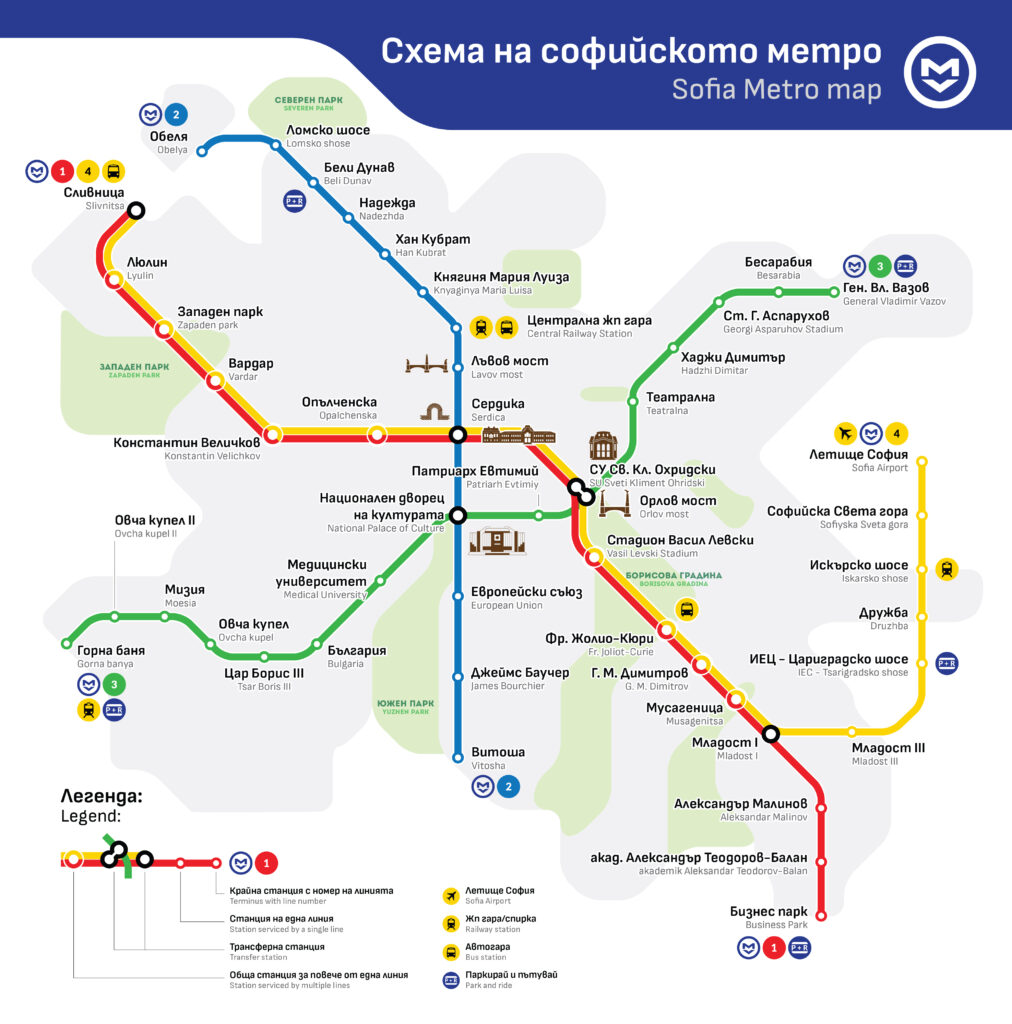
Sofia’s metro is the fastest and most efficient way to travel across the city. The direction of each train is clearly displayed on station monitors and announced in both Bulgarian and English.
If you arrive at Terminal 2 of Sofia Airport, the metro is the most convenient way to reach the city center. Additionally, it is a top choice for reaching key business hubs such as Business Park Sofia.
It is easy to learn how to get around Sofia by metro. The metro network consists of four lines. Lines M1 and M4 share 13 stations, however, before splitting, with one line heading toward Sofia Airport and the other toward Business Park Sofia.
There are currently four lines (M1–M4), connecting key landmarks, residential districts, and Sofia Airport.
- M4 (Extension): Connects Sofia Airport and the city centre with the western districts.
- M3 (Green Line): Links residential zones like Ovcha Kupel and Gorna Banya with the east side.
- M2 (Blue Line): Runs from the northern suburbs through the city centre to Vitosha district.
- M1 (Red Line): Covers the city centre, some of the newer neighbourhoods and the Airport.
When traveling from the city center to the airport with M1/M4, be careful with the line. At Mladost 1 Station is your last chance to get off and wait for the next train to the airport.
The metro operates daily from around 5:00 AM to 11:30 PM, with trains running more frequently during peak hours.
Note that the validators in the Sofia metro are on the left side of the door that opens to let you in. If by mistake you tap the device that is on the right side, the next door will open and you will have a few seconds to pass.
Main Metro Hubs in Sofia
You can change lines at three main interchange stations: Serdika, Sofia University, and NDK (National Palace of Culture). When you change the trains, use the transfer corridors and don’t exit the metro. You can continue your journey with the same ticket or card (if you use the pay-as-you-go option). You don’t have to validate new one!
The places where you can switch lines in Sofia are:
- Serdika 1 / Serdica 2 Station is nested in history, surrounded by ancient Roman ruins in the heart of the city. The two stations are for the lines M1/M4 and M2 . You don’t exit overground for a transfer. If you follow the signs and look for the transfer corridor. Serdica 2 (M2) is the one at a lower level.
- Sofia University / Orlov Most Station is right next to the Sofia University’s Rectorate. Nearby are the National Library and the National Art Academy. The area is close to one of the largest city hubs for the public transport – Orlov Most (Eagle’s Bridge). Line M3 is located at the lower level than M1/M4. If you prefer to save your energy, there is a travelator between the two stations!
- NDK 1 / NDK 2 (National Palace of Culture) is also in the city centre, the area is full of cafeterias, restaurants, and small shops. Vitosha boulevard is attracting crowds of locals and foreigners alike and the large square is often home of art or food markets, Spring or Christmas fairs. Here you changes between Lines M2 and M3, with Line 3 being on the lowest level.
Is the Sofia Metro Interesting?
Some metros around the globe are famous for their interior design or construction solutions and technologies. The Sofia metro isn’t one of them. The stations are not richly decorated as in some other countries, but there are nods to the history of the capital.
- Serdika 2 Station offers a glimpse into the city’s Roman past through a small exhibition of ancient ruins, while the nearby exit by the mosque leads directly into the heart of ancient Serdika (Serdica). Serdica was the name of the city of Sofia in ancient times.
- At Lavov Most (Lion’s Bridge), the station’s design reflects the architectural style of the area above. It creates a visually consistent experience underground.
- Teatralna Station is notable for the number of theatres in the area. Although the National Theatre is not among those nearby, the design of the station is a nod to its building.
Buses
Buses in Sofia cover the entire city, including many neighborhoods that the metro doesn’t reach. Most buses have digital displays in both Bulgarian and English, and many now accept contactless payments. Bus routes also connect to major landmarks like Boyana Church, National History Museum, and Vitosha Mountain. As a result, they are perfect for a day trip.
The contactless payment on Sofia public transport in the busses (day and night time) is the same as in any other means of transport. One taps the card and is good to go.
Some important bus lines for tourists visiting Sofia are:
- Line 61 and 63 will take you to the picturesque Zlatnite Mostove (The Golden Bridges) area in Vitosha mountain, with plenty of marked paths and picnic zones
- Line 63, 111, 304 winds its way to the Sofia Zoo and the charming Boyana district, placing you conveniently near the National History Museum‘s main entrance and the many trails leading into Vitosha Park, where you can immerse yourself in the great outdoors.
- Line 66 will take you to the emblematic Aleko hut which is almost on the top of the mountain and popular destination for locals.
- Lines 94 and 280 serve Studentski Grad (Students’ City), a district famous for its vibrant nightlife.. One upon a time this district was built primarily for university dorms, but later turned into a chaotic mix of entrepreneurship, party vibes and occasional school building.
Night Transport – Moving Around After Midnight
In addition to regular routes, there are four night bus lines that operate between 23:30 and around 4:00 in the morning, connecting major residential districts with long intervals, about one hour between buses. The night bus service in Sofia public transport signs are marked with the letter “N.”. All buses gather at the central square Alexander Batemberg so one can transfer from one line to the other.
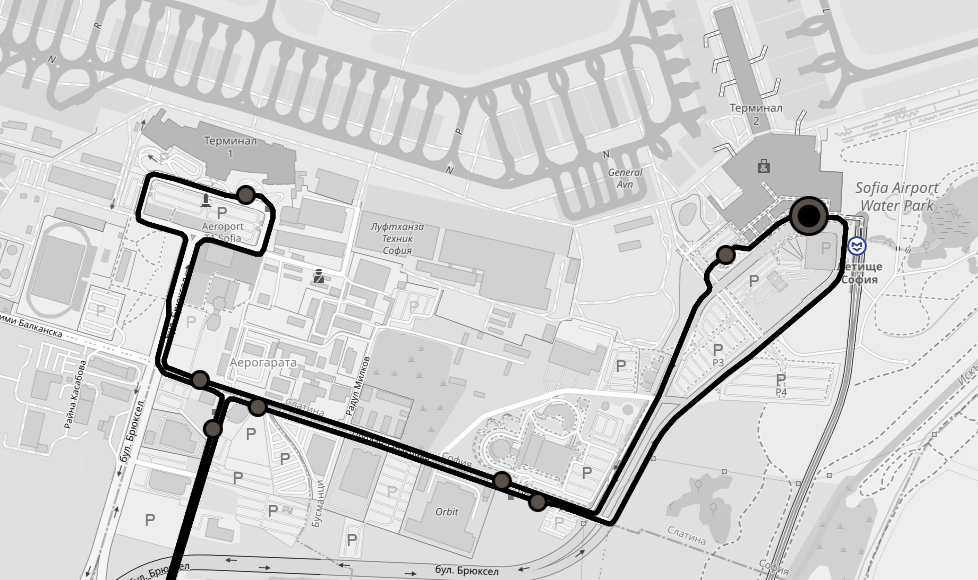
A great feature for travelers is the NIGHT bus service to Sofia Airport (Terminal 2 and 1). If you land after midnight and there are no more buses or metro trains for the day. Alternatively, if you are catching one of those budget 6 АМ flights, or if you don’t feel like spending on taxi, the NIGHT bus is for you.
- When travelling from the city center to the airport, the Night bus first stops at Terminal 1 and then continues to Terminal 2.
- When traveling from the airport to the city, the bus starts at Terminal 2, goes to Terminal 1 and continues its journey.
Buses are ideal for reaching attractions outside the city center. For example, buses 63, 110, and 111 run to the National History Museum in Boyana. In addition, buses 1 and 3 head directly to Pancharevo Lake for a scenic break.
Tourist Buses at the Price of Regular Trip (Double-Decker Sightseeing Buses)
For sightseeing, Sofia also operates double-decker tourist buses on weekends, which offer scenic rides to more distant attractions such as Vrana Park (once a royal residence) and the spa town of Bankya.
These double-decker routes, marked X43 and X50, run only on Saturdays and Sundays between 10:30 AM and 6 PM. The best part? While they offer a unique experience, they don’t require special tickets, standard public transport fares apply.
There are also regular daily bus lines to the districts of Pancharevo, popular with its lake and water activities, as well as parts of Vitosha Mountain.
Trams
Trams in Sofia are ideal for short to medium distances. In fact, their 12 lines efficiently connect central neighborhoods with outer suburban areas. In the city center, you’ll often spot them running along Graf Ignatiev Street, Alabin Street, and around St. Nedelya Square.
The best tram lines for tourists in Sofia are:
- Tram Line 10 is a charming option as it passes through the city centre, you will spot it along Graf Ignatiev Str. From the city centre it continues into Borisova Gradina Park, stopping at the picturesque Ulitsa Vishneva stop (Vishneva Str), known for its quaint little house that, while not open to the public, serves as a visual landmark.
- Tram Line 5 is another favourite,departing from a side street behind the Court of Justice and heading to the Knyazhevo district, a popular starting point for hikes into the nearby Vitosha mountain.
- Tram Lines 1, 3, 12, 27 will take you to/from the Central Train Station and Central Bus station.
Trams also conveniently link the city center with the Central Railway Station and the Central Bus Station. This makes them a practical and scenic mode of transport.
Keep in mind that trams reign supreme on city streets. The law firmly favours them. They don’t stop at zebra crossings or pedestrian crosswalks. They always have the right of way, and their drivers won’t hesitate if you end up in a collision with one.
Trolleybuses
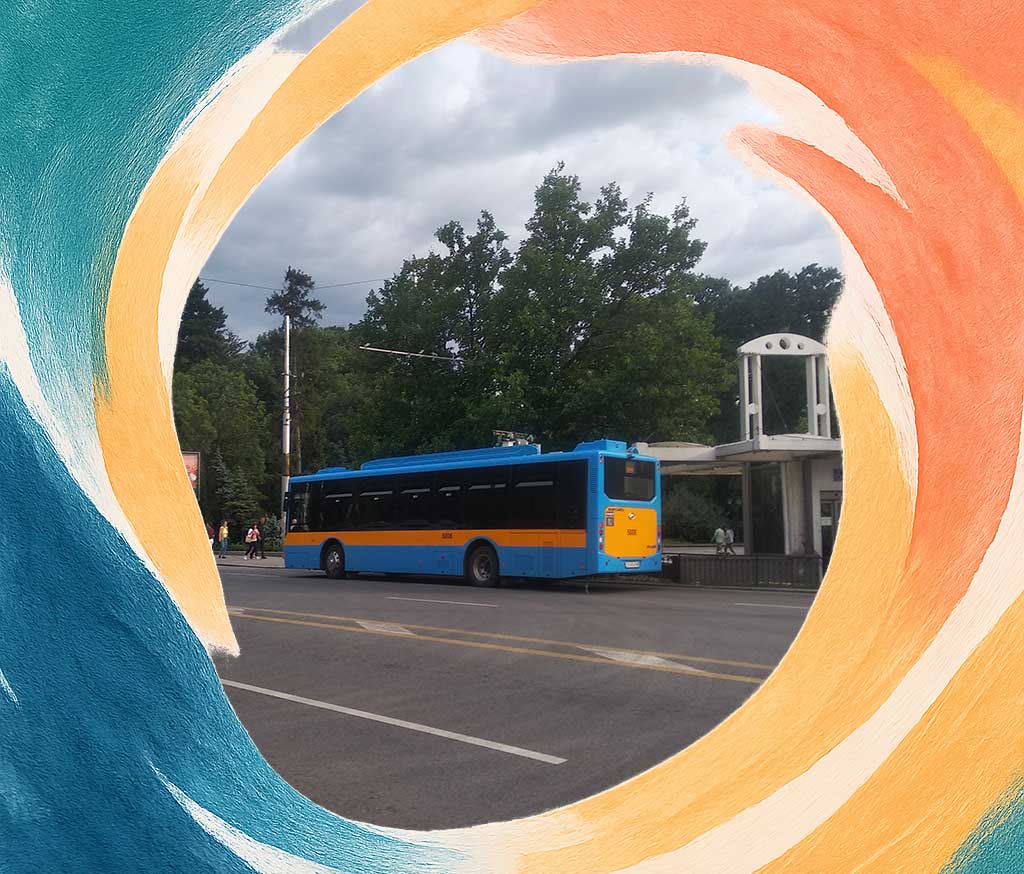
Trolleybuses run on over 10 routes in central and residential districts. They are convenient means of transport especially in the tourist areas between the Sofia University and the NDK-National Palace of Culture. Most of the vehicles on these lines are new, air-conditioned, and perfectly adequate for city travel.
There are also a few older models that run from time to time on some of the lines. You can spot them in the city center. If you are lucky, you can hop on an old blue trolley model Ikarus 280T for a nostalgic journey.
Fares for the Public Transport in Sofia
Sofia uses a unified ticketing system, meaning the same fare works for metro, buses, trams, and trolleybuses. Sofia ticket prices are in euro. The pricing for 2026 was approved by the Municipal Council.
The payment methods are:
- Using physical card – your credit or debit card
- Using physical card – buying the Sofia Ultralight Card
- Using PAYG – pay-as-you-go with your mobile device
- Using application
Validating the tickets on public transport in Sofia is required only when you get on the bus but not when you get off the vehicle.
Main Types of Tickets and Passes
Your best option for tourists is to pay with card or mobile phone/app (30+, 60+ fare). The drivers in the vehicles (buses, trams, trolleys) sell tickets but you can use them only on the specific vehicle and you can not transfer to other vehicles. Their price is 1,00 EUR.
You might find useful the Sofia2Go app which allows you to manage your spendings for the public transport in the capital.
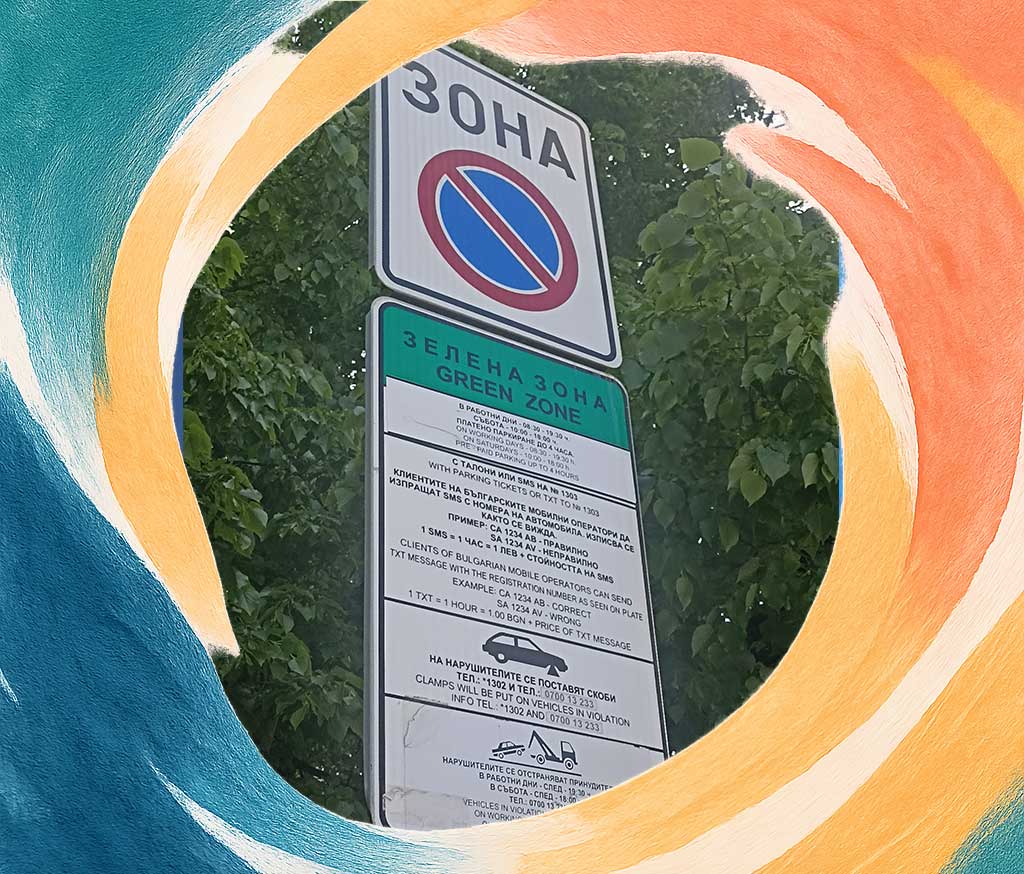
The Sofia Green Ticket is a special fare of 1 Bulgarian lev (0,50 EUR) available on days with a high risk of air pollution. You can’t buy one in advance, it is sold only on the days when there is high pollution and this is decided and announced by the Municipal Council.
Here is a list of all kiosk of the Urban Mibility where you can buy cards or tickets.
Full Table with Fares for the Public Transport in Sofia
| Fare | Used for | Timeframe | Price (2026 / 2027) | How to Pay |
| Single ride ticket purchased from the driver | When you have cash and you do not have or do not want to use your payment card | One ride only on the specific vehicle: tolley, bus or tram | 1,00 EUR | Cash or card if, IF for some reason, you cannot pay at the validators in the vehicle. |
| Single ride ticket purchased from a kiosk or machine | When you have cash and you do not have or do not want to use your payment card | One ride only: metro | 0,80 EUR | Cash |
| 30+ | Single journey or transfer from one to another vehicle (tram, metro, trolley or bus) | Allows you to travel or transfer for 30 minutes after the purchase | 0,80 EUR | PAYG, mobile phone app, contactless card, electronic wallet |
| 60+ | Single journey or transfer from one to another vehicle (tram, metro, trolley or bus) | Allows you to travel or transfer for 60 minutes after purchase | 1,10 EUR | PAYG, mobile phone app, contactless card, electronic wallet |
| Daily Pass | Allows for unlimited travel for one day on all means of transport. | For the “daytime” buses only. For the Night buses you will pay a Night fare. | 2,00 EUR | PAYG, mobile phone app, contactless card, electronic wallet |
| Night Pass | Allows you to travel on the Night buses only | Valid for the lines of the Night buses only (N) | 1,00 EUR | PAYG, mobile phone app, contactless card, electronic wallet |
| 24-hour Pass | Includes the daytime (trolley, trams, buses and metro) and night buses | Travel on all vehicles for 24 hours | 3,00 EUR | Available for purchase at some of the offices, or online, not possible to buy it as pay-as-you-go |
| 72-hour Pass | Includes the daytime (trolley, trams, buses and metro) and night buses (N) | Travel on all vehicles for three consecutive calendar days after activation | 7,60 EUR | Available for purchase at some of the offices, or online, not possible to buy it as pay-as-you-go |
| Includes the daytime (trolley, trams, buses and metro) and night buses (N) | Travel on all vehicles for three consecutive calendar days after activation and get special discounts at museums and shops | In 2026: 10,20 EUR | The “Sofia Card” has been discontinued after failing to secure the planned discounts at key sites. There are plans for relaunch. | |
| Fine for a single journey | This is a special ticket that the ticketing inspector issues to the person who doesn’t have ticket or hasn’t payed one by card or app | It is for the specific journey and you can’t transfer to another vehicle with the document for the fine | 20,00 EUR | If you can’t pay or refuse to pay, the inspectors take you off the bus (they call the police if you refuse) and write you an administrative violation notice. It is an administrative act, similar to a traffic police report for a Road Traffic Act violation. |
| Green Ticket / Green Card | Ticket issued on high pollution days | It is valid for the whole day. Learn how in our dedicated article. It is not valid for the Night buses | 0,50 EUR | Cash on offices and kiosks, Cash in some of the centres, PAYG, mobile phone app, contactless card, electronic wallet: it is automatically calculated for the specific day |
| White Ticket / White Card | Issued on very special occasions * * i.e. never | As decided by the municipal council | FREE | On very special days * the government of the city can decide to make the transport free. |
| Fares for children | Children up to 7 years travel for free | All means of transport | FREE | If the inspector says that the child looks older, you can use any personal document to prove age. |
Paying with a Contactless Card or Electronic Wallet (Pay-As-You-Go)
The most convenient way to pay for public transport in Sofia is by using the pay-as-you-go system with a contactless Visa or MasterCard, or a mobile wallet on your phone or another NFC-enabled device.
The 30-plus or 60-plus ticket allows you to transfer within 30 or 60 minutes of the first validation. When transferring, it must be revalidated in each subsequent vehicle but you won’t be charged extra for each validation. All tickets can be used with a bank card (Pay-As-You-Go).
If you make more than two journeys using the 30-plus fare with the same bank card in one day, the system will automatically cap your spending and charge you for a daily pass (2.00 EUR) instead. The final amount due is calculated after 00:00 on the day following the card’s use.
Just tap your card or device on the validator when boarding. You’ll see a green light, hear a beep, and get a message confirming the validation. If you’re unsure whether the payment went through, you can tap again within 5 minutes of the first attempt. In case the light turns red or you see an error, try using a different card or choose another ticket option such as mobile app (the Sofia2Go app).
Pay-As-You-Go and Ticket Inspectors
If a ticket inspector checks your fare, simply tap the same card or device you used when entering the vehicle. The inspector’s device doesn’t charge your card, it only verifies that your ride was validated.
Make sure each passenger uses a separate card or device for validation.
If your card couldn’t be authorized, it may be on a restricted list maintained by your bank or the Sofia Urban Mobility Centre. Use another card or ask at the kiosks of the Mobility Center. There are options to get a chip card and validate it as you would do with any pay-as-you-go card.
Pay-As-You-Go in Sofia: Do I Need a Separate Card for Each Person?
Yes, each person needs their own card when using the public transport in Sofia. This allows the system’s fare-capping feature to work.
For example:
- You take 3 short trips (30+) * 0,80 EUR each = 2,40 EUR
The usual trip fares total 2,40 EUR but when you use the same card for all trips the system will charge you just 2,00 EUR.
- You take 2 transfer trips * 1,10 EUR each = 2,20 EUR
These two trips cost 2,20 EUR but when you use the same card for all trips the system will charge you just 2,00 EUR.
Alternatively, you can use the Sofia2go app or MPass mobile app (iOS and Android) to purchase single trips and day passes directly with your card. It is useful when you pay for a travel companion.
Buying Paper Tickets or Card for the Public Transport in Sofia
If you’re unable to use the pay-as-you-go system due to card restrictions or technical issues with your bank or the payment system, don’t worry, you still have options.
For the metro lines you can purchase tickets from the machines located at metro stations. These machines accept cash and cards to print paper tickets. In addition, when using the metro, you do not need to buy or validate a new ticket when transferring between lines (provided you remain inside the stations).
For buses, trolleys, and trams you can buy paper tickets from the transport vehicles but the price is 1,00 EUR and it is only for the particular trip, you can not transfer to other vehicles.
Make sure to validate your ticket / card as soon as you board by tapping it on the onboard validator. Random checks are common, and riding without a valid ticket may result in a fine. Be aware that some inspectors can be rather curt or unfriendly.
A budget-friendly alternative for short-term visitors is the Ultralight Chip Card. Ideal for tourists and occasional travelers, this disposable card costs just 0,40 EUR and can be reloaded multiple times. How much you load depends on you. It supports only short-term fares, such as 30-minute, 60-minute, daily, or 72-hour passes, which is more than enough for most visitors.
You can buy the Ultralight Chip Card at various authorized kiosks, including those at Serdika Metro Station, Sofia Airport, and the Central Bus and Railway Stations. A full list of locations is available on the official Sofia Urban Mobility Centre website, where they’re also clearly marked on a map.
Using Mobile Applications
Sofia Municipality has been criticized for the lack of a well-functioning “official” app for tickets. However, tapping a card or phone on the validators is reasonably easy, reducing the need for an additional app.Nonetheless, several third-party apps are available. MPass is one of them, and it is compatible with both iOS and Android.
Another app, Sofia Plus, also targeted public transport at launch, but it now primarily handles paid street parking.
Public Transport Schedule, Apps and Real-Time Tracking
Google Maps provides accurate schedules for all metro, bus, tram, and trolleybus lines in Sofia. Furthermore, it also estimates travel times based on real-time traffic conditions and notifies you of any delays. You can even track the vehicle’s movement on the map as it approaches your stop. Although official apps are available, we recommend Google Maps for its excellent performance. Google Maps is among the tips for tourists using public transport in Sofia we always recommend.
You can check the news section on sofiatraffic.bg for updates and announcements related to all types of public transport. It includes route changes, service notices, and useful information about lines to Vitosha Mountain and nearby satellite villages often visited by tourists.
An interactive map and timetable are also available on the official website.
Three Takeaways for Seamless Urban Experience in Sofia
Mastering Sofia’s public transport is the key to unlocking Bulgaria’s vibrant capital with ease and affordability. From the speed of the metro connecting you to the airport, to the charming trams rolling through the city centre, and the buses that carry you up the slopes of Vitosha Mountain, your adventure is well within reach.
Here are the 3 most important things you should remember:
- One Ticket, One Network: A single fare grants you access to the entire integrated network of metro, trams, buses, and trolleybuses.
- Your Bank Card is Your Ticket: The simplest way to pay is by tapping your contactless card or device on the validating machines.
- The Metro is Your Backbone: Use it for cross-city travel, especially to the Airport, Central Station, and major hubs.
Grab your card, step out, and explore Sofia like a local. Its efficient, budget-friendly transport network is ready to take you where you want to go.
FAQ About the Public Transport in Sofia
There are several ways: you can buy a single ticket from the driver, pay by card by tapping it on the machines inside the buses, or use a digital wallet by holding your phone near the validators.
Children under 7 travel for free. For children aged 7 to 14, free travel is possible upon presenting proof of local address registration. As most tourists and visitors are unable to provide this, a fare is required for all children over the age of 7.
The unified city ticket is valid for the “Sofia Urban Zone,” which covers the entire metropolitan area, including the outer neighborhoods, parks, and populated places. The list of all lines can be found on the website of the public transport.
All tickets are unified and valid for the entire city network during the daytime. The price of a ticket to the airport is the same as the price of any other ticket. Night buses have higher fares.
All timetables for all lines can be found on the website of the Center for Urban Mobility. The schedules are also available in Google Maps. When you are at the stop, the electronic displays (especially for the metro and trams) show when the next vehicle arrives.
Check your terminal. By metro (M4) to T2 is the fastest and most reliable way. A standard city ticket is valid. T1 is served by bus lines 84 and N1 (N for night). Google Maps will calculate the optimal route for you in real time, using your current location and desired destination.
By metro (M1, M2, M4 – station “Tsentralna Zhelezopatna Gara”) or by numerous tram and bus lines.
To find the best route, enter your destination in Google Maps; it automatically uses your current location to suggest the optimal path.
You can easily reach it by metro (M1, M4 – station “SU St. Kliment Ohridski”), as well as by trolley lines 1, 2, 3, 4, 6, 8, 11. Bus lines bus lines 84, and 94 stop a walking distance from there. As well as Trams 20, 21 and 22 (stop National Opera). Google Maps will calculate the optimal route for you in real time, using your current location and desired destination.
There are night buses, marked with the letter “N” before the number (e.g., N1, N2, N3, etc.). They serve the main directions in the city after the daytime lines stop running (around 11:00 PM – 12:00 AM).
The metro operating hours are from 5:00 AM to 12:00 AM (midnight).
Yes. You must tap your card or scan your mobile ticket on the validator each time you board a vehicle or enter the metro station, regardless of the type of pass you hold. Validating your card serves as official proof of travel. In the event of an accident, this validation record is required to process any insurance claim.
Yes, but you must present valid documentation (e.g., a student ID or pensioner certificate) to purchase and use discounted fares.
When a ticket inspector asks to check your ticket, present your paper ticket or tap the same card/device you used to board. If you paid by card or via an app, show it to them. The inspectors will scan it and check if the ticket is valid. Always remain calm and cooperative.
Yes, the system is designed with maximum security. The inspectors’ devices cannot see your card details or balance, and they are incapable of withdrawing money from your account. Their only function is to verify that your journey was properly paid for.
Useful Links
- List of all kiosks of the Urban Mobility Centre where you can buy cards or tickets (with online map to locate the closest to you)
- The Official website of the Urban Mobility Center of the Sofia Municipality
- Metropoliten, the official website of the Sofia Metro
- Sofia2Go app on Andoird (Apple devices are not supported yet)
- Sofia Public Transport: The Complete Guide
Hop on the Bus!
As you can see, getting around Sofia doesn’t have to be complicated. With a unified ticketing system where a simple tap of your bank card grants you access, and a network that stretches from the ancient ruins in Serdika station to the stunning peaks of Vitosha Mountain, you have the freedom to explore it all. And if public transport sounds too complicated for your taste, you may find our urban mobility guide handy, full of useful hints on other means of transport such as car sharing, eScooters, eBikes & Bikes and, of course, taxis.
You are now equipped with all the essential knowledge: from choosing between a 30-minute ticket or a daily pass, to understanding the metro lines and scenic bus routes. Public transport is the smart, sustainable, and surprisingly charming way to experience the real Sofia.
So, validate your ticket, find a seat, and enjoy the journey. Your Sofia adventure awaits!
This complete guide to Sofia public transport in 2025 provides everything you need to know for getting around Bulgaria’s capital easily and affordably. Learn about the integrated network of metro, trams, buses, and trolleybuses. Discover how to use the convenient pay-as-you-go system with your contactless bank card, understand ticket prices and types (including the 30-minute, 60-minute, and daily pass), and get insider tips for using the system like a local. The guide also covers night transport, routes to the airport and Vitosha Mountain, and the best apps for real-time tracking.
# #Sofia public transport, #Sofia metro, #trams in Sofia, #how to get around Sofia, #Sofia ticket prices 2025, #Sofia Green Ticket, #contactless metro Sofia, #Sofia transport apps