Tucked against the forested lower slopes of Vitosha Mountain, the Boyana Residence is one of Sofia’s most intriguing secrets. It is an address where Bulgaria’s political history, artistic heritage, and quiet luxury meet. Most travellers know Boyana for its UNESCO-listed medieval church or the vast National History Museum. Far fewer realise that the surrounding residential complex, built as a seat of power during the socialist era, is not only a symbol of state prestige but also a place where you can actually stay overnight.
Once a discreet enclave for political elites, Boyana today remains one of Sofia’s most desirable and guarded neighbourhoods with remarkable architecture. The Boyana Residence, with its imposing modernist lines, landscaped park, and elegantly aged interiors, offers a rare window into a world usually hidden from public view. This is not the typical place visitors search for when choosing where to stay in Sofia. Yet for travellers who enjoy unusual hotels, retro charm, or a touch of Cold War intrigue, the Boyana Residence Sofia stands out as a destination in itself.
The Boyana Residence is the brightest and most authentically preserved example of socialist-era representative architecture in the country. Its architecture, layered history and the chance to walk the same corridors as political leaders, offer an unforgettable way to experience Bulgaria’s capital.

TL;DR – Why Visit (or Stay at) the Boyana Residence
- Stay in a Time Capsule and Sleep in House 2, a preserved 1970s state-residence hotel
- Museum in a Monument: Explore House 1, home of the National History Museum
- A Peek Into Power: Walk through Sofia’s most secure, prestigious neighbourhood
- Architecture Lovers’ Dream: Discover authentic socialist-modernist design
- Nature at Your Doorstep: Enjoy landscaped gardens and rose alleys
- Myth & Mystery: Hear legends about the secret “Tunnel of Power” said to run beneath the complex.
- Photo-Perfect Setting: Mountain backdrop, manicured lawns, and cinematic interiors
- Easy Escape From the City: Just 15–20 minutes from downtown Sofia, yet it feels worlds away.
- Boyana at First Glance: Sofia’s Most Guarded Neighbourhood
- From Mountain Village to Power District
- What Is the Boyana Residence? Understanding Bulgaria’s Seat of State Prestige
- Architects of Power: How Boyana Became a Socialist-Era Masterpiece
- House 1: The National History Museum
- House 2, Boyana Residence Hotel: Stay in a Living Time Capsule
- Home for High-Profile Politicians
- Sculpted Nature: Park, Garden, and Green Legacy
- The Legend of the Tunnel of Power
- Beyond Power: The Best Things to See in Boyana
- How to Get to the Boyana Residence
- FAQ About Boyana Residence
- Useful Links
Boyana at First Glance: Sofia’s Most Guarded Neighbourhood
Nestled high on Sofia’s southern edge, Boyana immediately feels different from the rest of the capital—quieter, greener, and unmistakably exclusive. The district sits where the city meets the foothills of Vitosha Mountain, giving it a cool alpine breeze in summer and sweeping views over the urban valley below. Elegant villas, embassies, and discreet government buildings hide behind tall hedges and guarded gates, contributing to Boyana’s reputation as one of Sofia’s most secure neighbourhoods.
Despite its prestige, Boyana remains wonderfully accessible. Visitors come for the National History Museum, the UNESCO-listed Boyana Church, and the nearby hiking trails, yet few realise how much of the area’s identity has been shaped by the presence of the Boyana Residence Sofia. It is this combination of nature, culture, and quiet authority that makes Boyana stand out. This part of the town is part leafy suburb, part seat of power, and entirely unlike anywhere else in the city.
From Mountain Village to Power District
Long before Boyana became home to presidents, diplomats, and visiting heads of state, it was a small mountain village tucked beneath Vitosha’s forests. For centuries, it sat on the edge of the city, known mainly for its fertile land, cool climate, and the medieval Boyana Church—a jewel of Bulgarian spirituality and artistry.
Boyana’s transformation began in the late 19th and early 20th centuries, when Sofia expanded southward and the area’s strategic elevation attracted the attention of Bulgaria’s political and cultural elite. By the mid-20th century, during the socialist era, Boyana had become a preferred location for state institutions and high-ranking officials. The construction of the Boyana Residence in 1970s solidified its new identity, turning the once-rural settlement into a carefully planned power enclave.
The Boyana Residence complex was designed and built in the 1970s. The place was chosen by the Bulgarian government for its strategic location near three of Sofia’s major boulevards: Bulgaria, Alexander Pushkin, and Bratya Bukston. In fact, Boulevard “Bulgaria” was built specifically to connect this enclave directly to the city center.
The complex became home of the Bulgarian totalitarian elite and in the modern era Boyana keeps being residential magnet for the elite: the presidents, prime ministers and other public figures. Its transformation from pastoral hamlet into center-stage enclave was a gradual yet deliberate process.
Today in this district you can observe its village past with decades of national significance, creating a uniquely layered sense of place.
What Is the Boyana Residence? Understanding Bulgaria’s Seat of State Prestige

The Boyana Residence Sofia, is the country’s most symbolic seats of power. Built during the socialist era as a secure, self-contained complex for Bulgaria’s highest-ranking officials, it was designed to host state ceremonies, diplomatic meetings, and historic political decisions. Even today, much of the compound remains active. It serves as the official residence of Bulgaria’s presidents and accommodating visiting foreign leaders.
But the Boyana Residence is also surprisingly accessible to the public. Certain areas, especially House 2, operate as a hotel, allowing guests to stay within a setting that once defined the nation’s inner political world. The atmosphere is unlike anywhere else in Sofia. It is quiet, impeccably maintained, and steeped in a subtle, almost cinematic sense of gravitas.
The Buildings in Boyana Residence
Buildings are named Dom 1, Dom 2, etc. “Дом”, meaning “House” or “Building” in Bulgarian, as part of a systematic, utilitarian naming convention typical of state-run facilities from the socialist era. This style of labelling (numbered and generic), especially common in administrative, residential, and institutional complexes built, was used under communist regimes, where practicality and hierarchy took precedence over decorative or personalised naming.
- House 1 (Dom 1): Originally this was the State Council’s ceremonial and diplomatic headquarters. It was built in the 1970s by architect Alexander Barov and now houses the National Historical Museum.
- House 2 (Dom 2): A stately hotel complex built in the 1970s by architect Stefka Georgieva. It was designed for elite guests: government officials, foreign dignitaries, and today, adventurous travelers.
- House 3 (Dom 3): A staff residence from the late 1940s.
- House 4 (Dom 4): A former guard post, never residential.
- House 5 (Dom 5): A 1910 summer villa now used to lodge high-level officials.
- Houses 6–8 (Dom 6-8): Additional secure residences completed in 1974 for official use. Today they are under controlled access and they are unlikely to be seen by regular visitors.
All buildings are nestled in a meticulously designed park. The layout unites varying scales and functions in a harmonious, hierarchy-driven ensemble: domestic, ministerial, ceremonial.
Architects of Power: How Boyana Became a Socialist-Era Masterpiece
The Boyana Residence is a state complex with a special status. It is an architectural showcase of ambition, authority, and prestige. The Bulgarian state residence was built in the 1970s by Glavproekt’s government-design creative atelier. It was the institution tasked with designing signature state projects and its buildings were carefully planned.
The architectural identity of the Boyana Residence was shaped by Bulgaria’s most respected designers of the late socialist era. The names include renowned professionals like Aleksandar Barov, Stefka Georgieva, and Valentina Atanasova. Their vision combined the clean geometry of modernism with materials and motifs that reflected Bulgarian cultural traditions. The result was a series of buildings that looked both contemporary and deeply rooted in place. Boyana Residence features structures defined by marble, granite, copper roofs, and generous use of natural light.
Far from being merely functional, the residence was conceived as a carefully choreographed environment of power. The architects designed grand halls for political assemblies. It also included discreet suites for visiting delegations, and pathways that allowed movement between buildings without attracting attention. These features gave the complex an almost cinematic aura.
The landscape around the residence was just as intentional. Terraced lawns, rose gardens, and tall pines softened the strict lines of the architecture. They created a retreat-like atmosphere that contrasted with the intensity of its political use. Together, the buildings and grounds represent one of the finest examples of socialist architecture in Bulgaria. That is making it a masterpiece where aesthetic ambition and state authority quietly coexist.
The Expansion of Boyana Residence
The Government of Bulgaria has provided land in the Boyana district of Sofia (part of the Boyana residence) to the Bulgarian Football Union (BFU) for the construction of a training base for the national teams. That is how here in 2016 popped up the Bulgarian Football Union’s state-of-the-art sports base.
Spread across three modern buildings, the complex features three pristine football pitches and two well-kept tennis courts, ideal for both rigorous training and relaxed recreation. Spectator stands offer a front-row seat to the action, while the on-site hotel welcomes guests with cosy rooms and a peaceful setting. The campus also houses the official headquarters of the Bulgarian Football Union, alongside a fully equipped medical and recovery centre designed to keep athletes in peak form.
House 1: The National History Museum

When you step into House 1, now the National Historical Museum, you’re entering a living artifact itself. This cubic, imposing building once sheltered Bulgaria’s highest echelon of state power. For decades this building served as a ceremonial hub of socialist Bulgaria, hosting high-level meetings, receptions, and state events. Its monumental façade of marble and glass feels intentionally commanding, hinting at the political gravity it was built to contain.
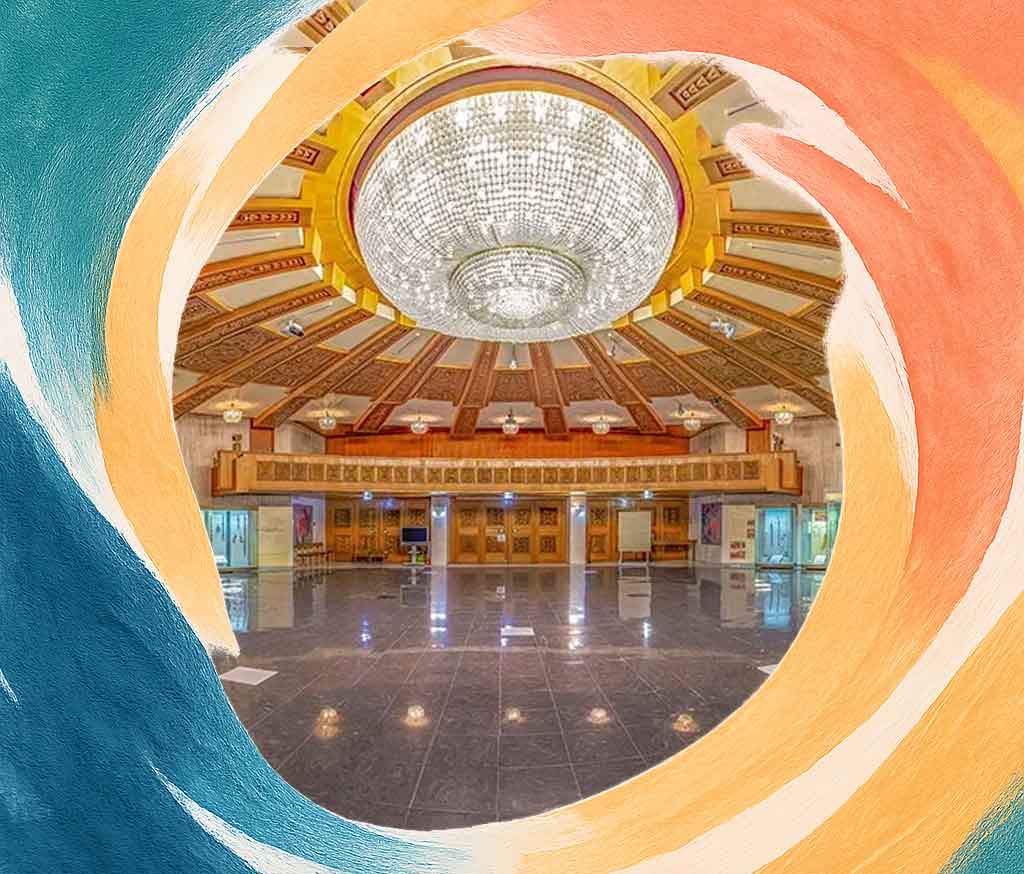
Today the vast entrance hall opens into a sequence of galleries that showcase more than 1,300 years of Bulgarian history. Here, Thracian gold, medieval frescoes, royal treasures, and contemporary archives are displayed. The building’s original design is still clearly visible. It features sweeping staircases, geometric chandeliers, and spacious halls that once echoed with speeches now frame historical exhibitions.
Massive glass enclosures flood the grand staircase with daylight, framing panoramic views of Vitosha’s peaks. Through its windows, you glimpse the halls where decorations were awarded, credentials handed over. The building’s layout, with folding doors and flexible chambers, was considered cutting-edge in 1970s socialist architecture.
Interestingly, this building was copied many times after that in a number of representative government buildings throughout the country. It is one of the most valuable examples of our post-war architecture. Its design, refined and replicated in other state structures around Bulgaria, marries the grand gestures of Renaissance Revival with a sleek modernist restraint. Cantilevered bays evoke the sweeping eaves of Revival-era homes. The interiors radiate with warm browns, soft whites, lush reds, and tobacco greens. The palette evokes wood, marble, carpet, and nature in one harmonious symphony.
Interior Highlights of the National History Museum
The iconic ceiling in the grand chamber known as the “Sun Hall” features a conical vaulted wood-paneled dome. It has radial beams and a central glass sphere. Following the architectural style, its design reimagines traditional Bulgarian “sun” motifs in a modern context. Master woodcarver Kacho Grozev and sculptor-engraver Anton Donchev crafted it under the guidance of architect Alexander Barov. Its artistry matches only the renowned panels at Sofia’s National Palace of Culture.
Particularly poignant is the plenary hall. In this hall, on 10 November 1989, the Communist Party officially deposed Todor Zhivkov, igniting Bulgaria’s democratic transformation. Once a stage for party congresses and international state affairs, the same halls now host foreign delegations and cultural functions.
House 2, Boyana Residence Hotel: Stay in a Living Time Capsule

Imagine waking up in authentic 1970s state luxury, with a distinctly retro charm. That’s House 2, the Boyana Residence Hotel, where you can now spend nights, not just diplomats or officials. The central hotel complex is intended for visitors. It has two wings and both were extremely luxurious for their time. Today, despite renovations by the state, they are maintained, but a retro spirit is felt. For lovers of authentic experiences, the place is wonderful.
Opened to public bookings after major renovations in 2017, it preserves its vintage character. It has marble floors, wooden ceiling panels, Austrian anodised aluminium frames, and a copper roof. The building is nearly 30,000 sq.m in total. It houses two restaurants, conference rooms, a spa, pool, cinema, and a fitness centre.
Rooms and suites vary in size, but many still display the original layout and décor chosen for diplomatic comfort. Here you will discover generous floor plans, panoramic balconies, and an atmosphere of quiet, understated prestige. Staying here is less about modern extravagance and more about ambience.. A rare experience with a touch of history.
Special Stay
Rumor has it that apartment A-32 is the crème de la crème. It is approximately 280 m², with living room, dining area, office, two bedrooms, two bathrooms, wardrobe. Archives show it was once graced by Queen Margrethe II of Denmark, King Carl XVI Gustaf of Sweden, King Juan Carlos of Spain, and even the Dalai Lama.
For travellers seeking a memorable and slightly cinematic experience, House 2 Hotel Boyana Residence delivers a rare glimpse into the lifestyle of Bulgaria’s political elite. House 2 still hosts high profile guests, national sports teams and corporate forums. Though visiting foreign delegations have become rare since 2000, the atmosphere of muted state splendour remains tangible. The most impressive is the lobby with its classic styling and warm marble-and-wood tones.
You can book at the official website https://travel.government.bg/kompleks-boiana.
Home for High-Profile Politicians
The Boyana Residence complex is a fully functioning home of the Bulgarian government. Unlike House 1 and House 2, these buildings are not open to the public, yet their presence is essential to understanding the enclave’s purpose. Designed with discretion in mind, the villas (Dom 6, 7, 8) combine elements of modern architecture with the comfort and security
Within the complex sits Villa “Kalina” the official home of Bulgaria’s presidents. While some choose their own private homes, “Kalina” remains a central, secure locus of presidency life, complete with 24/7 National Security Service protection, staff chefs, cleaning teams, and dedicated groundskeepers. Although visitors cannot enter, its significance is palpable across the estate. Villa Kalina embodies Boyana’s ongoing political role, connecting the modern Bulgarian presidency to the site’s earlier life as a restricted zone for state officials. In a district defined by status and symbolism, Villa Kalina stands as the ultimate expression of both.
Prime Ministers and other heads of Bulgarian institutions also can reside in the buildings here. Not all officials live here but all have used the buildings during their office years.
Notable Exceptions and Implants in Boyana Residence
Security plays a central role in the Boyana Residence and some of the Bulgarian prime ministers and presidents have learned this in a remarkable way.
- In the 2000s, then president Georgi Parvanov initially planned to live in his apartment as an ordinary citizen. But he soon saw that this could not happen. His security guards were posted on the staircase of his the block. Parvanov felt that it was not appropriate for both the security guards and the neighbours, so he moved to Boyana Residence.
- In the 2010s, then president Rosen Plevneliev made a massive renovation to turn the presidential place from a living-oriented place into an office-like space. He himself lived in an extremely luxury gated complex newly built by one of his development companies. He was a construction entrepreneur before he entered politics.
- Interestingly, former Prime Minister Ivan Kostov in the late 1990s chose to remain in his home in nearby Dragalevtsi district. Due to this, the government added a wooden observation tower there for his security detail.
- During his tenure in 2000s, Simeon Saxe-Coburg-Gotha, the son of the last Bulgarian tsar from the 20th century, continued living in his royal family estate Vrana Palace, just outside Sofia.
- In the late 2010s the Chief Prosecutor, Ivan Geshev, occupied Villa 5 in Boyana Residence after a major refurbishing. He was criticised by many for living at the public’s expense in a complex designed for the government, the Executive, and those directly chosen from the people, and not the Judiciary.
Sculpted Nature: Park, Garden, and Green Legacy
The grounds of the Boyana Residence form one of Sofia’s most beautifully maintained green spaces. A carefully sculpted parkland stretching between the main buildings. Engineer-architect Valentina Atanasova masterfully designed and supervised this landscape. Her impressive resume includes the gardens of Sofia’s National Palace of Culture, the Sunny Beach resort, Tunis’s Olympic Sports Park, the landscape of Algeria’s government compound, and more. She created a thoughtfully tiered landscape of pines, broadleaf trees, lawns, botanical corners, rose gardens, aviary and model airplane fields, and tennis courts.
In 2017, just before Bulgaria’s rotating EU presidency, a major restoration effort revitalised the entire landscape. Landscape architects reshaped overgrown sections, modernised irrigation systems, and reintroduced rare native species to align the park with its original mid-20th-century aesthetic vision. Crews removed over 500 diseased trees to prevent infestation by the bark borer, an insect threatening the trees. They replaced them with a mix of coniferous and broadleaf saplings, restoring the park’s vitality in time for high-level summits and diplomatic receptions. The restoration brought back the clarity of the residence’s design philosophy: harmony, order, and natural beauty intertwined.
Boyana is, above all, a green refuge: a place where nature and architecture converse in pine-cone rustles and sunlight-patterned marble floors.
The Legend of the Tunnel of Power
No complex as politically charged as the Boyana Residence would be complete without a whisper of mystery. For decades, rumours have circulated about a secret underground tunnel connecting the residence to key government buildings in central Sofia. Some claim that the tunnel was built it for emergency evacuations; others suggest that it served high-ranking officials as a discreet passageway during the socialist era.
An official confirmation has never been released, but the rumour persists. People fuel it with the residence’s secure layout, restricted zones, and the undeniably cinematic appeal of hidden Cold War infrastructure. According to legend, a secret underground passage links the Parliament building at Largo to Boyana Residence. Though the state built ambitious “tunnels of power” during Zhivkov’s rule, it never fully completed the specific passage under Parliament. Construction workers apparently buried it during the metro’s construction.
In fact Sofia boasts over 200 km of catacombs beneath it, but most are metro-era utilities, with only a few traceable emergency or escape tunnels tied to state security operations.
Whether the tunnel exists or not, the myth adds an irresistible layer of intrigue to the Boyana Residence. It reminds visitors that this quiet, green enclave was once a stage for political choreography, where discretion and control were paramount. In a place where history and secrecy intersect so seamlessly, the truth may well be just as fascinating as the legend.
Beyond Power: The Best Things to See in Boyana
Boyana’s appeal extends far beyond bricks and bureaucracy. Beyond its imposing government residences, Boyana reveals itself as Sofia’s green sanctuary, where history, art, and nature converge. Nestled on the slopes of Vitosha Mountain, this district offers a unique journey from the world-renowned frescoes of its UNESCO-listed medieval church to the thundering beauty of the Boyana Waterfall.
- Boyana Church: The 10th-century “St. Nicholas and St. Pantaleon” Church known as the Boyana Church, is UNESCO-listed. It has remarkable history and stunning medieval frescoes. It miraculously survived Ottoman rule and only narrowly escaped demolition in 1912 but survived to this day. This is thanks to Queen Eleonore’s intervention. Her memory lives on by the church, where she was laid to rest.
- Boyana Waterfall: A short hike higher up the mountain unfolds into a natural spectacle—epic in spring with melting snow from Cherni Vrah feeding the cascade. It’s one of Vitosha’s most photogenic and invigorating spots.
- Boyana Lake & Hydropower Station: Constructed in 1908, and operational by 1923, this artificial lake and its hydroelectric facility supported Sofia’s early electrification—making it one of the city’s pioneering renewable energy sites.
- Boyana Film Center: The cinematic epicentre of Bulgaria. It’s hosted Bulgarian classics and global blockbusters like Den of Thieves, The Expendables 2, even Conan the Barbarian. Year-round it opens to film crews, festivals, Christmas bazaars, and parties.
Boyana is a place where you can trace the contours of modern Bulgarian history. And then, just like that, escape into serene parkland and pine-scented air within minutes.
How to Get to the Boyana Residence
Probably the easiest way to reach the Boyana Residence is by taxi or rent-a-car.
If you feel like exploring the city and its public transport system to the uncharted territories of the governmental residence, rest assured that you can do it!
| Public Transport | Comment |
|---|---|
| Bus 304 | My personally favourite. It has stops at all major transport hubs such as Pliska on Tsarigradsko shose, Orlov Most (Eagle’s Bridge), the bus stop near the Vasil Levski Metro Stration on Evlogi Georgiev boulevard, National Palace of Culture NDK – the bus stop under the Lover’s Bridge. Buses run every 20 minutes on weekdays but once per hour on the weekends |
| Bus 63 | The bus line runs along Tsar Boris III boulevard which is its closest stop to the city center. The line serves the Zlatnite mostove (translated to Golden Bridges) on Vitosha mountain. The picturesque area is popular weekend hiking destination. On the weekend buses run every 20 minutes and on the weekdays – once per hour. |
| Bus 111 | The bus runs line runs every 10 minutes and will give you unforgettable urban decay views of the capital’s Ring Road. Unfortunately its stops are far from the city centre. You can catch metro to Mladost 1 station or if you feel like more adveturious – to Lyulin metro station, located in the same name district |
While you’re at it, you might enjoy diving into one of the tours focused on Bulgaria’s Communist-era heritage.
FAQ About Boyana Residence
Yes, but partially. House 2 operates as a hotel, and the National History Museum in House 1 is open to the public. The residential villas for officials are strictly off-limits.
Yes, in House 2, which functions as a government hotel open to private bookings, offering a unique “retro” experience.
Typically, access to some of the park-like grounds is included with the museum ticket or the hotel stay, but specific areas are restricted.
Useful Links
- National History Museum in Boyana
- Boyana Residence on the website of Sofiaplan (PDF from the municipal enterprise responsible for the spatial and strategic planning of the Sofia Municipality)
- Boyana Church (official page on the website of the National History Museum)
- Boyana Church (on UNESCO’s official website)
- Nu Boyana Studios (corporate website)
Visiting Sofia’s Most Unexpected Address
Exploring the Boyana Residence feels like stepping into a living archive of Bulgaria’s modern history, one where state ceremonies, diplomatic intrigue, and artistic ambition quietly shaped the country’s narrative. Yet it is also a strikingly peaceful retreat. It is surrounded by pine trees, rose gardens, and the fresh mountain air that still defines Boyana’s identity.
Whether you wander through the museum halls of House 1 or relax in the retro-luxury suites of House 2, the experience is unique. It brings you closer to the grandeur of Bulgaria’s socialist-era architecture. It unfolds the intimacy of a neighbourhood that has always stood slightly apart from Sofia’s urban tempo.
Boyana Residence is for travellers looking for something different, an unusual place to stay. It offers a deeper cultural encounter or a story worth retelling. Here, history isn’t just displayed, it is lived.
If you choose to make Boyana your base in Sofia, you’ll discover a district where the past feels close. Here Bulgaria’s capital reveals one of its most unexpected faces. In a city full of contrasts, the Boyana Residence remains one of its most unforgettable.